Will it replace us one day?
Let’s be honest: the question has crossed all our minds. AI impresses, sometimes worries. It automates, accelerates, transforms. And yes, it is already reshaping certain jobs.
But when it comes to the store, I wanted to take a different perspective. A more concrete, more operational, and more human one. A reflection inspired by a round table organized by one of our partners, Findle.
Today, it has become imperative to do better with purpose. And it is around this conviction that I would like to open the discussion.
Making room for “doing better with purpose”
Operational excellence has always been a topic of focus. But in a context of low growth and lasting pressure on performance, it is now asserting itself with even greater force.
New technological tools, and AI in particular, offer powerful levers to gain precision, responsiveness, and flexibility. However, these tools will only deliver lasting impact if teams truly take ownership of them. Moreover, in the face of recruitment and retention challenges, the issue is also about making people want to join and stay on the shop floor.
Meaning therefore naturally becomes a central issue. Working on operational excellence alone is no longer enough. We must restore meaning to daily practices and to the use of new tools in order to turn expected performance into tangible reality. Because technology and agility, as essential as they are for identifying disruptions and adjusting or correcting in real time, only create lasting impact when teams fully embrace them.
Giving meaning means enabling everyone to understand why things are done, in what order, in what way, and how each action fits into a collective project. This is precisely where subsidiarity comes into its own. No longer management making decisions from afar, but employees on the ground, as close as possible to reality, who act and decide within a clear, shared, and well-understood framework, calling on the manager when necessary. An approach that turns meaning and engagement into concrete and lasting action.
Setting the framework to unleash initiative
To enable employees to make effective decisions as close to the field as possible, they must first be given the right reference points. And above all, the right information.
Two levers then become essential.

AI as an everyday co-pilot
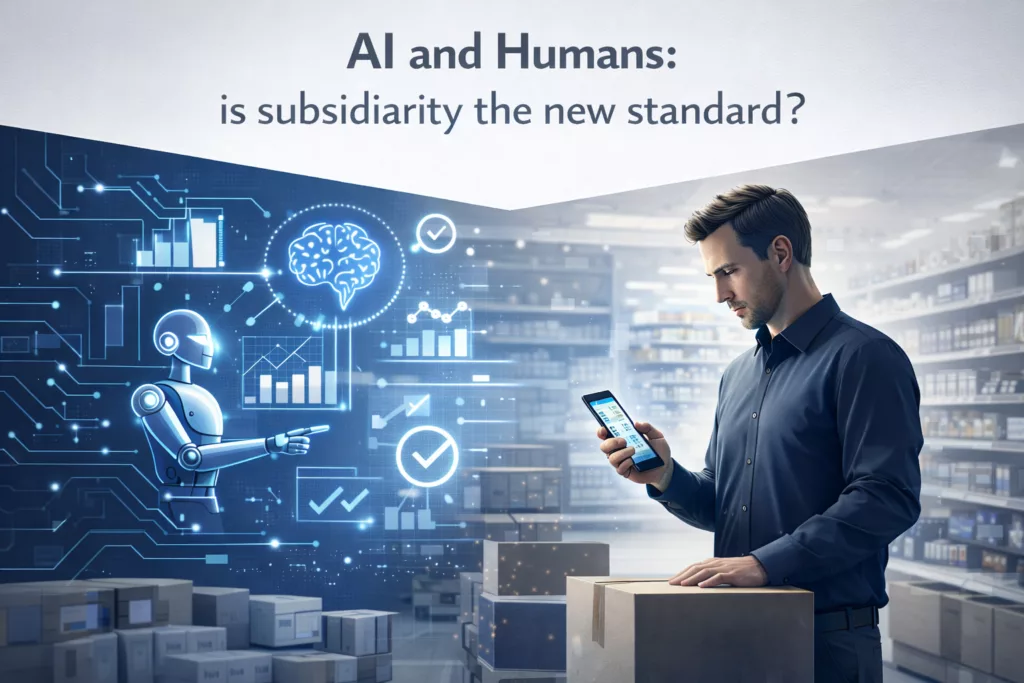
Opposing humans and AI makes no sense to me. Artificial intelligence should first and foremost be thought of as a co-pilot. A support. An accelerator of discernment.
Concretely, it:
- Facilitates real-time decision-making. By analyzing and synthesizing large volumes of data, AI helps employees and managers decide faster and more accurately.
- Secures risk-taking. It confronts on-the-ground intuition with global trends and improves overall consistency.
- Frees up mental bandwidth. By automating administrative tasks and formulating recommendations, it gives humans back time for what really matters.
Thus, the final decision always remains human. And that is a key point.
This is precisely the choice we have made at TimeSkipper. Our solution supports managers on a daily basis in their organizational decisions and hour allocation. We provide recommendations, scenarios, and insights. But we deliberately leave control in the hands of the manager. It is up to them to arbitrate, adjust, and decide.
Training as a driver of meaning and autonomy
This technological transformation disrupts habits and calls for a new way of managing. Employees must appropriate digital tools; otherwise, these technologies, although designed to improve their daily work and store performance, risk being abandoned… or leveraged by competitors ready to adopt them.
The manager of 2026 plays a central role here. They must support their teams, develop their autonomy, and give them the means to make decisions themselves, at the right time.
Concretely, this involves:
- Providing the necessary training so that everyone has the skills needed to act.
- Guaranteeing the right to make mistakes: without it, there is no initiative; without initiative, no local innovation.
- Giving meaning: explaining the “why” so that everyone can intelligently adapt the “how”.
- Clarifying priorities: the morning briefing then becomes a key moment to set direction and guide quick decisions throughout the day.
The “Dream Team” at the heart of performance
“Doing better with purpose” strongly resonates with the vision shared by Alexandre LOIZEAU during our conference at Tech for Retail. By placing training at the heart of the store, we truly give the field back its power to act. And we respond to the search for meaning expressed by new generations. The result? More autonomous, more engaged, and more responsive teams.
Conclusion: the operational excellence of tomorrow
Will it replace us one day? The article opened with this almost instinctive question. In closing, my conviction is clear: AI does not replace humans in stores, it reveals them. Humans remain in control of its use.
Operational excellence is no longer solely an economic or technical objective. By reconnecting strategy, tools, and on-the-ground reality, we can indeed do better with purpose. Not only to face upcoming challenges, but above all to create environments where autonomy regains its place… and where every hour truly counts.