Walmart is the world’s leading food retailer, with more than 10,700 stores, $647 billion in revenue for fiscal year 2024, and over 2.1 million associates across five continents.
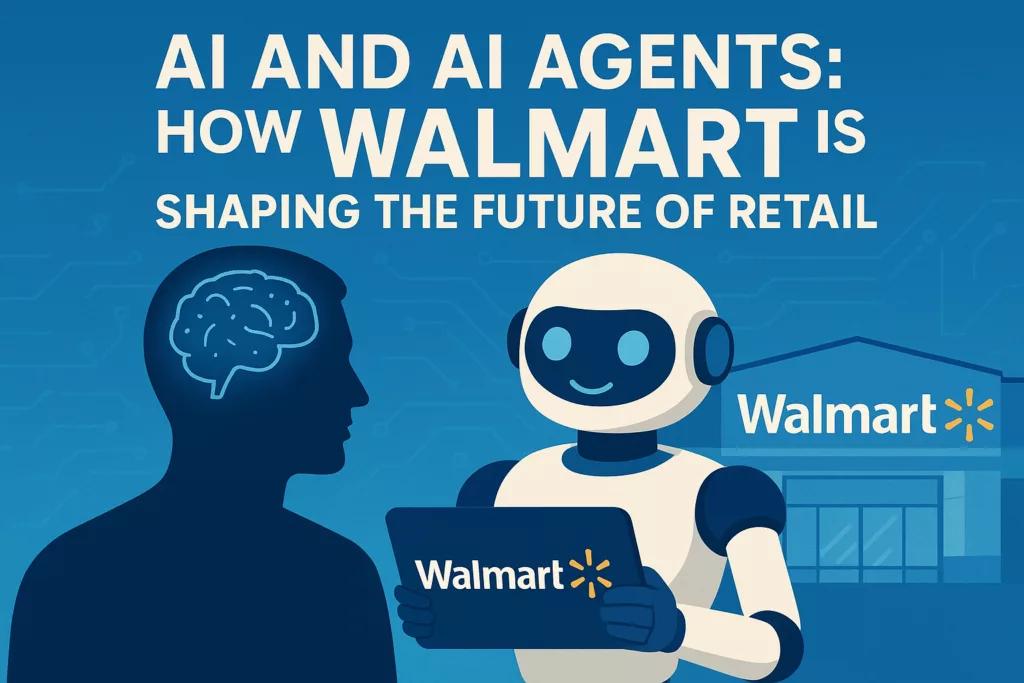
Recently, Walmart reached a new milestone in its digital transformation. Through a partnership with OpenAI, the company unveiled Instant Checkout, an innovation that could reinvent the way consumers shop in the coming years. And that’s not all: its CTO, Suresh Kumar, also announced the creation of four AI “super agents,” designed to collaborate with one another to support associates, anticipate needs, and streamline the customer experience. A strategy fully aligned with the company’s vision: “People-led, tech-powered.”
But what does this mean in practice? How is the U.S. giant already using AI to orchestrate operations, prevent stockouts, optimize schedules, or detect anomalies? And, most importantly, what lessons can European retailers draw from it? Let’s break it down.
Walmart: an innovation-driven organization
In recent days, the world’s most famous food retailer announced that it will leave the NYSE on December 9 to join the NASDAQ alongside major tech players. This says a lot about the company’s desire to be perceived as a technology-driven organization. But what does this look like in practice?

Walmart’s technological backbone is Walmart Global Tech. This division is responsible for building all AI solutions and managing the company’s digital infrastructure.
To ensure that innovation is quickly turned into measurable value, Walmart recently appointed Daniel Danker to a brand-new role: Head Global AI Acceleration, Product & Design. Reporting directly to the CEO, he is responsible for accelerating and overseeing the global rollout of AI initiatives.
It’s also worth noting that Walmart Tech includes Walmart Commerce Technologies, a division focused on commercializing internal solutions to other retailers, transforming internal R&D costs into a new revenue stream.
In short, Walmart has built a highly effective technology organization capable of rapidly driving innovation across its entire store network.
AI super agents: a new intelligent orchestration layer
In July 2025, Suresh Kumar announced a major advancement at Walmart: the deployment of four advanced AI agents designed to create a unified ecosystem for managing operations and simplifying the lives of customers, store associates, and partners.
Here are the four agents and their roles: [1]

- Sparky: the personal shopping assistant : Powered by AI, Sparky helps customers by answering detailed product questions or broader queries such as “What do I need for a birthday party with this theme?” It uses store data, customer reviews, and product sheets to generate personalized shopping lists.
- Associate agent: the store team assistant : Designed for store associates and managers, it helps plan schedules, answer HR or product questions, and open support tickets, reducing time spent navigating internal systems.
- Marty: the supplier and advertiser support agent : Marty centralizes and manages orders and simplifies the creation of seamless advertising campaigns for suppliers and sellers.
- Developer Agent: the developer-focused AI : This agent supports developers by assisting with coding and enabling AI-assisted testing and quality control.
Together, these agents aim to manage and centralize existing AI systems and data. Sparky, already live, currently oversees all AI and data connected to customer interfaces. The Associate Agent — yet to be launched — will likely orchestrate the AI systems behind the Me@Walmart associate app. Over time, these agents may interact with and even supervise one another. This unified approach marks a significant shift from today’s fragmented models. [2]
But what about AI at the store operations level?
[1] : https://www.analyticsvidhya.com/blog/2025/08/ai-in-retail/
[2] : https://public.walmart.com/content/walmart-global-tech/en_us/blog/post/all-in-on-agents.html
AI for smoother store operations
AI for Teams: scheduling, autonomy, and recognition
True to its mantra, “people-led, tech-powered,” Walmart places people at the center. Its goal is to simplify employees’ work and increase satisfaction, ultimately improving the customer experience.
This is the purpose of Me@Walmart, the internal app developed for associates. Through the app, employees can view their schedules, access all their tasks, and see which activities should be prioritized based on real-time store updates. [3]
Managers can adjust schedules based on data flows (customer traffic, stock levels, sales). AI provides recommendations. Managers can also track completed tasks and employee skill development in real time.
With this app, Walmart anticipates, plans, and manages in real time, boosting autonomy and accountability. The result: higher motivation and fewer unproductive hours.
[3] : https://youtu.be/_4Ng7gZ0JkM?si=fPATSsABUJ8nRGxi
AI at the heart of Walmart’s inventory management
Beyond distribution centers, home delivery, and pickup operations, Walmart has heavily invested in technologies to optimize product flows and inventory.
From detection to automation
Initially tested in 2020 (with Bossa Nova robots), shelf monitoring has evolved into computer-vision tools that automatically detect stockouts. [4]
More recently, in 2024, Walmart partnered with Vusion Group to develop Edge Sense, a sophisticated shelf-management system using smart rails, centralized communication, ultra-precise geolocation, and Bluetooth connectivity. [5]
IoT and RFID in harsh environments
Walmart now integrates battery-free IoT sensors (powered by radio waves or light) to track product location, temperature, and freshness in real time.

In cold and humid environments, Walmart partnered with Avery Dennison to create RFID sensors tailored for categories like meat, bakery, and deli. The goal: reduce food waste, ensure product freshness, and provide associates with faster and more accurate stock information. [6]
AI for healthier inventory
Walmart uses AI to forecast demand by analyzing past predictions, trends, upcoming events, and market signals. It also provides a unified view of store and warehouse inventory.
Combined with AI and IoT systems, stock anomalies are detected and corrected automatically: a sudden spike in demand triggers immediate replenishment while weather events automatically adjust supply chain flows. AI also identifies damaged or expired products upon arrival.
Result: products are in the right place at the right time, with fewer unnecessary stock backups.
[4] : https://thespoon.tech/report-walmart-to-stop-using-bossa-novas-shelf-scanning-robots/
[5] :
https://www.vusion.com/fr/newsroom/walmart-etend-deploiement-solutions-vusiongroup-ensemble-magasins-etats-unis/
[6] :
https://corporate.walmart.com/news/2025/10/22/walmart-and-avery-dennison-collaborate-to-enhance-freshness-and-increase-operational-efficiency-using-rfid
Anomaly detection and predictive maintenance
Using digital twins, Walmart creates real-time virtual replicas of its stores. These digital twins [7] monitor equipment and conditions, enabling predictive maintenance. The system can anticipate refrigeration failures up to two weeks in advance and automatically generate work orders, avoiding emergencies and product waste.
[7] :
https://www.retaildive.com/news/walmart-artificial-intelligence-ai-super-agents-retail-associates/753996/
What european retail can learn
A gap in scale and underused applications...
Europe leads in AI regulation, but store-level innovation, while progressing, remains slower than in the U.S.
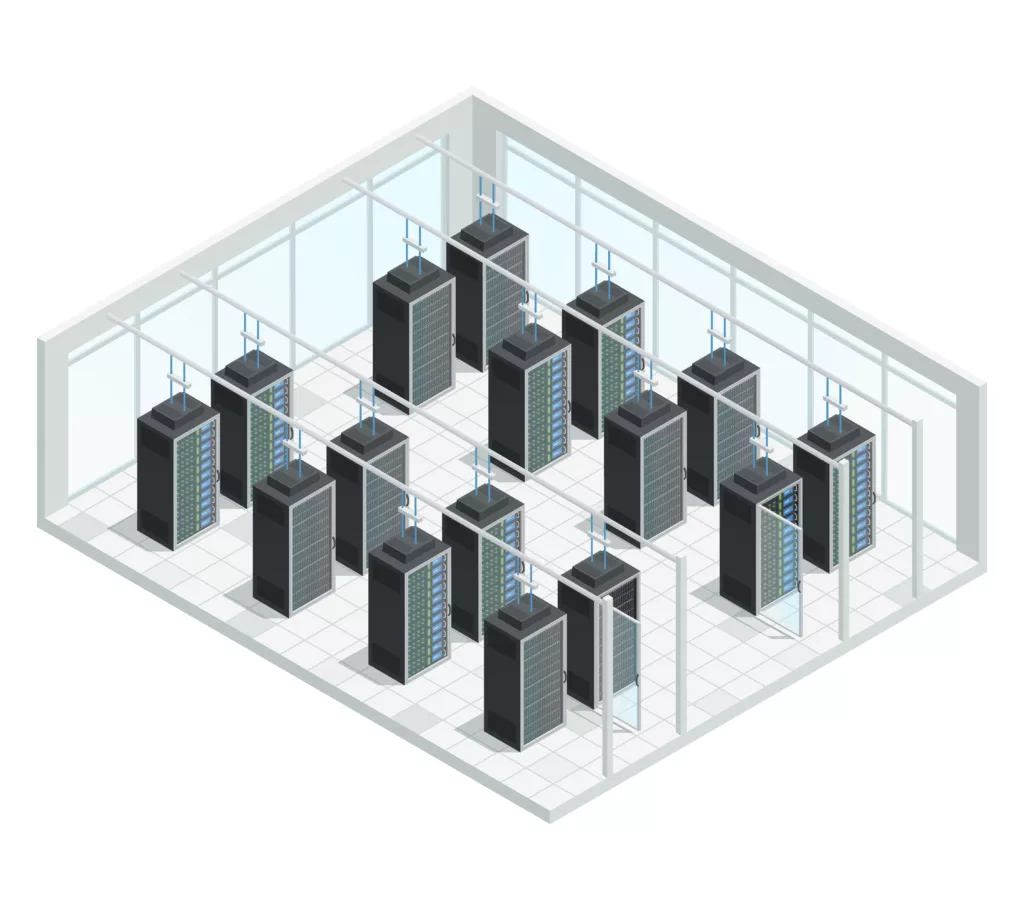
Some encouraging developments are appearing, such as large-scale data-center investments. The Schwarz Group recently announced a €11 billion mega-data-center project, aiming to gain autonomy from providers like Amazon or Google.
In France, similar initiatives are emerging:
- Carrefour has committed €5 billion (2018–2026) for e-commerce, AI, and retail media.
- Les Mousquetaires (Intermarché) are focusing on a centralized cloud platform (Databricks).
- Leclerc’s Infomil is modernizing and expanding data-center capacity. [8]
New tools are also appearing, personalized recommendations, stockout prevention systems (from companies like Vusion Group or Hanshow), and theft-detection technologies. Yet, despite this momentum, execution remains slow.
A key opportunity, still underused, is operational efficiency, one of Walmart’s strongest pillars. This is precisely where TimeSkipper fits in.
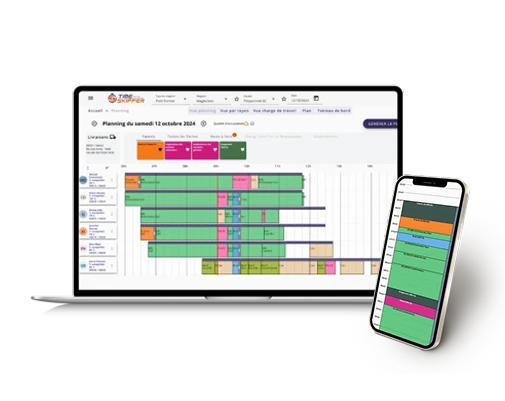
The challenge is not just having the right people, but having them at the right time, in the right place, working on the right task based on real-time priorities. TimeSkipper enables this by ensuring the right balance between staffing levels and actual workload. Real-time management and mobility also increase autonomy, engagement, and satisfaction.
[8] : https://www.jebosseengrandedistribution.fr/2025/11/19/pourquoi-les-enseignes-investissent-dans-les-data-centers-et-comment-linfrastructure-devient-le-nouveau-terrain-de-bataille-du-retail/
...key lessons to take away
What happens in the U.S. often arrives in Europe shortly after. To anticipate what’s coming, here are four strategic priorities:
Real-time activity management for “precision retail”
Walmart shows that high-performing stores adjust continuously: tasks, inventory, schedules, and priorities. When growth slows, every micro-optimization matters.
Treat AI as an assistant, not a supervisor
“People-led, tech-powered” means technology only creates value when it empowers associates by simplifying their work and supporting their decisions.
Anticipate instead of reacting
Sudden demand spikes, weather disruptions, irregular deliveries… everything is identified and handled before the store feels the impact.
Centralize Data for Smooth Orchestration
The power of AI super agents lies in unified data. Connecting and synchronizing data is now essential for deploying intelligent systems that truly support store teams.
Conclusion
Walmart is setting new global retail standards. Its people-led, tech-powered approach shows that performance comes not from technology alone, but from the synergy between human intelligence and artificial intelligence.
What Walmart is experiencing today, other retailers will experience tomorrow: a retail environment where every hour, task, and interaction is optimized, not to go faster, but to work smarter and with more purpose.
This is where TimeSkipper contributes to the transformation: by helping teams embrace these technologies, orchestrating new in-store tasks, and ensuring they are completed, all while keeping associates firmly in control of their decisions.