Close your eyes for a moment.
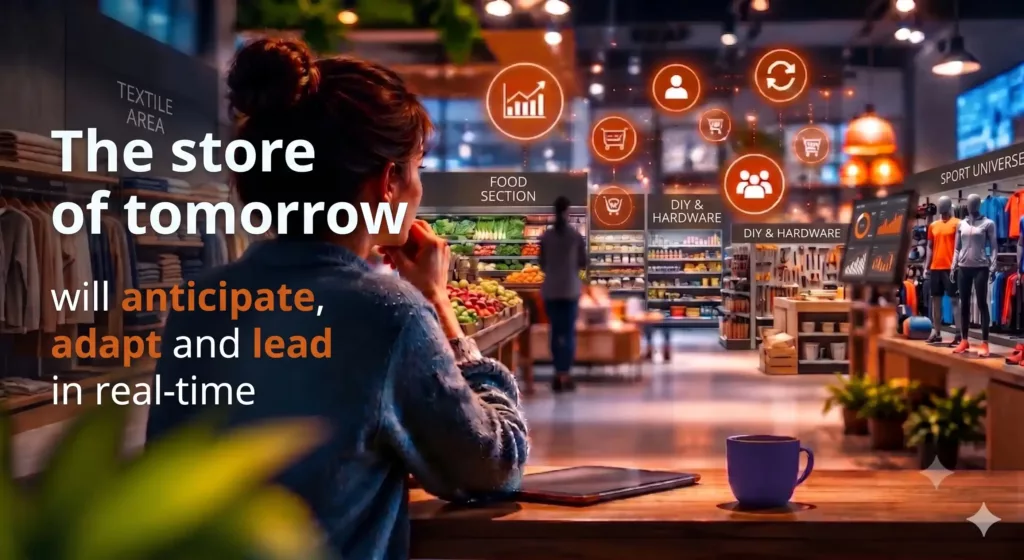
And imagine the store of tomorrow.
Predictive analytics capable of anticipating activity, AI agents that assist both teams and customers, tools capable of adjusting priorities in real time…
Well, open your eyes, because all of this already exists. But in store, the reality is different. Even though points of sale today have access to data and a multitude of tools, few exploit them to their full potential. As a result, many still operate in “action-reaction” mode, driven by the rhythm of on-the-ground emergencies.
And this gap becomes all the more critical as the rise of AI-driven search agents and tools online is pushing physical stores to raise their standards. When a customer visits a brick-and-mortar store, they expect the same level of fluidity — if not more — to be satisfied. In this context, intuition-based management no longer has a place!
Moreover, if anticipating is a first step, one must also know how to react in real time when faced with the unexpected. And to achieve this, one prerequisite naturally emerges: centralising the data useful to store operations in a single tool. A solution capable of transforming that data into priorities, then assigning them to turn into concrete actions. Without this, the data exists — but has no operational value.
So how can stores better anticipate, better react and manage in real time to guarantee an optimal customer experience? Let’s take stock.
The right product at the right time in the right place with the right advice at the right price
The right product at the right time in the right place
Product availability is managed today through a combination of mobility, IoT (Internet of Things) and artificial intelligence.
Anticipating the right product at the right time in the right place
Real-time management of in-store and back-of-house stock
Shelf availability is permanently monitored. Mini-cameras or scanning robots move along the aisles and measure shelf stock levels and the presence of each product reference. Coupled with real-time sales analysis, they anticipate stockouts before they are even visible to the naked eye. By predicting a likely stockout, the majority of so-called “NOSBOS” (an item present in the stockroom but not on the shelf) and “visual stockouts” (planogram errors) are thus eliminated.
A planogram that shifts with the trends
Speaking of planograms, artificial intelligence also serves to anticipate needs and continuously optimise assortments. Tools will be capable of identifying shifts in consumer behaviour before they become visible on a large scale. A product gaining momentum, the imminent end of a trend, a change in usage… Planograms will gradually become dynamic. Resets will thus be more frequent and more precise, as they are directly driven by on-the-ground data. Finally, planograms will “flag implantation inconsistencies before they become visible to the consumer” [1]. In an unstable economic climate where consumer habits evolve quickly, managing based solely on historical data is no longer sufficient. Anticipating the right product in the right place at the right time is essential.
Reacting when the product is not available
Sales associates equipped with a mobile device can immediately verify any information requested by a customer. No more back-and-forth trips to the stockroom: equipped, they can confirm in the blink of an eye whether an item is available on-site, at a nearby store, or even at the central warehouse.

Thanks to the concept of the “endless aisle“, they can even order any missing product on the spot and arrange home delivery for the customer, thus avoiding having to say the word “no”.
Dynamic pricing: adapting prices to customers?
Dynamic pricing has already existed in transport, hospitality and e-commerce for some time. In physical retail, the subject is more delicate and is progressing more cautiously. But according to some research, it could improve the profit margin of companies that use it by 5% [2].
Electronic shelf labels already make it possible to adjust prices much more quickly while improving price harmonisation and reliability across all stores. But a question is beginning to emerge due to the customer data collected: how far will price personalisation go?
Across the Atlantic, consumers already fear that prices will be adjusted based on their data. Some claim to have seen this in stores, but nothing has been confirmed. Legislators are therefore raising their shields in response to consumer concerns.
This is the case in New Jersey [3] and Maryland [4], where a law was recently enacted to prohibit this practice (it does not apply to all sectors). In Europe, transparency is equally crucial to maintaining trust. But rather than personalised prices per customer (which would cause a scandal), loyalty programmes are what prevail!
But perhaps we can imagine instead, prices that change based on product shelf availability for promotional items? Or prices based on supply and demand with local suppliers subject to agreements?
That raises a lot of hypotheticals. So, will any of this ever happen? Nothing is less certain. What is certain, however, is that it is generating discussion.
Anticipating the right number of sales associates at the right time
Consumers are already searching for and comparing products through AI assistants, or conversational tools capable of recommending the best options in seconds. So, when a customer makes the trip to a physical store, their level of expectation is much higher — that goes without saying! The store will therefore need to offer what AI agents cannot (yet?) replace:
- Advice and interaction to share a passion, experiences…
- Bringing products to life through experiences (touching, testing the product)
- Providing services such as repairing a bicycle, cutting a plank of wood…
In short, an irreproachable service and customer journey!
But to reach this level of service, or even to offer more, sales associates must be available at the right time in the right section.

Activity management tools such as TimeSkipper already use historical data, anticipated customer flows, promotions and local events to adjust team organisation down to the nearest quarter of an hour. It consequently guarantees the optimal presence of sales associates with integration of background tasks. Concretely, the associate carries out tasks that can easily be suspended when footfall increases and advice is requested.
This approach delivers a high ROI. An assisted customer converts, on average, up to three times more than a customer left alone [5]. By anticipating flows and better organising working time, the store therefore mechanically improves its conversion rate while streamlining the shopping experience.
Preventing activity peaks and absences
Suffering from activity fluctuations and absences should not exist. And yet, they are the main factors of disorganisation in stores. So how can they be prevented? Let’s get into it!
Preventing and managing activity peaks
Promotions, weather, local events, seasonality or commercial operations — all of these factors can multiply footfall in store. It is therefore crucial to integrate these variables in order to anticipate customer flows and staffing needs before, during and after the peak. And for this, workload calculation is the greatest asset. This is how TimeSkipper, armed with its expertise, has developed an activity simulator to size teams from the beginning to the end of the activity peak [link], by week or by day depending on the desired granularity. When the peak arrives, anticipating each day, the day before, and reacting quickly to the unexpected will be child’s play.
Preventing and managing absences in store
In store, absenteeism is a daily reality and can quickly disorganise teams. However, by planning the team schedule in advance with TimeSkipper, the manager knows each day what their room for manoeuvre is for the following day. And in the event of an unplanned absence, they can easily and instantly identify the operational impact:
- What tasks was the absent person supposed to carry out?
- Which tasks should be reassigned as priorities and which should be postponed?
- Which colleagues are capable or available to absorb the absent person’s tasks?
By visualising the impact of the absence at a glance, the manager reallocates tasks without disorganising or overburdening the teams present. It should also be noted that, upstream, TimeSkipper contributes to improving the sense of fairness within the team. The solution ensures, each day, the equitable distribution of workload among team members.
Centralising data to make it actionable in the field
All the data mentioned in this article — from product availability to sales advice and promotion management — converges towards the prerequisite mentioned in the introduction. To anticipate and react in real time, in order to guarantee an optimal customer experience, it will be necessary to bring it all together in a single tool. A tool capable of sorting, prioritising and assigning it to team members so that it is materialised into concrete actions in the field.
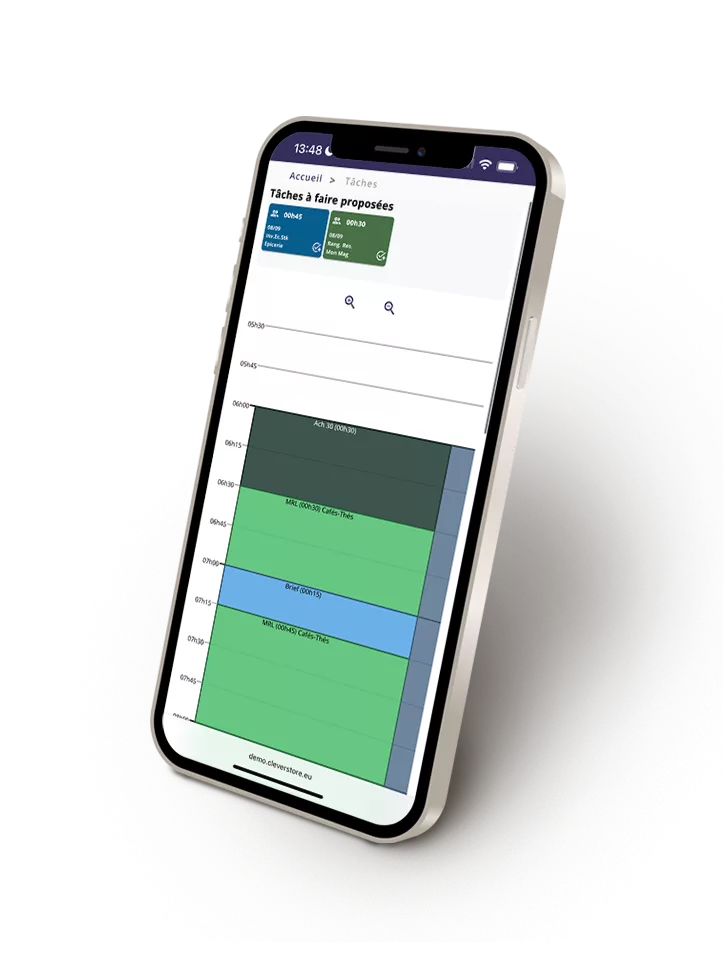
This is how TimeSkipper centralises all information related to:
- merchandise flows
- e-commerce flows
- customer flows
- store tasks (and the exact time they take)
- stockouts
- skills
- operational priorities
to ensure their continuous coordination, and to make it possible to anticipate work organisation and react in real time thanks to mobility [link]. At a time when every hour of work counts and every detail influences the customer experience, making every minute count is not a luxury: it is a performance driver.
In short, the store of tomorrow will need to enable teams to be more proactive
The store of tomorrow will know how to anticipate and adapt in real time to meet the growing demands of the customer experience that weigh on physical stores. To do so, retailers capable of continuously orchestrating their data, their teams and their operations will gain a competitive edge. Fewer stockouts and wasted time, greater sales associate availability and therefore better revenue. The future of retail means having already reorganised teams before the problem even appears.
FAQ: the store of tomorrow
How can stores better anticipate activity?
Stores can anticipate activity using historical data, various flows (customer, merchandise, promotions…), weather and local events. Combined with activity management tools such as TimeSkipper and AI, this data makes it possible to adjust teams and priorities in real time.
Why is 'intuition-based' management no longer sufficient in stores?
Customer expectations are evolving rapidly, particularly under the influence of e-commerce and conversational AI tools.
Physical stores must now raise their standards and therefore anticipate, react faster and better organise teams to guarantee a smooth experience and purchasing journey at every moment.
What is real-time store management?
Real-time management means adjusting priorities, tasks and resources according to the store’s actual activity.
This makes it possible to better handle the unexpected, peak footfall or absences. Made possible thanks to the mobile version of TimeSkipper.
How does artificial intelligence help stores?
AI can help stores anticipate stockouts, analyse customer behaviour, optimise planograms and forecast staffing needs based on expected activity.
Why has centralising store data become essential?
Centralising data is no longer simply a matter of collecting information, but of transforming it into concrete actions. By bringing together all useful data in a single tool, the store can prioritise tasks, better coordinate teams and react more quickly to the unexpected. Data then takes on its full meaning: it becomes a genuine operational lever in the field.
Sources
[1] Journal du Net – AI no longer predicts retail trends; it prevents the sector from making mistakes
Voir la source
[2] Zuora – Dynamic Pricing
Voir la source
[3] TF1 Info – Is a major supermarket chain using AI to adjust prices in real time?
Voir la source
[4] Morgan Lewis – Maryland Enacts HB 895
Voir la source
[5] Studies and observations carried out during in-store consultancy visits