Tech for Retail at the end of the year, NRF in New York, then Euroshop… You could not have missed them as we have heard so much about them! All of these trade shows, at this end and beginning of the year, are the testimony that a wave of innovations is surging through the retail sector and more specifically across points of sale.
And I must admit that, when looking at all the exhibitors, one no longer knows where to turn. Because everywhere, innovations are presented with promises that are more or less spectacular…
But looking closer, one question remains in my mind: among all these innovations, if I had to retain only a few, which ones would they be? Which ones would ultimately allow for the concrete improvement of in-store operations?
Because in the end, product promises are all well and good, but they still must be kept. There is no point in putting in technology for the sake of putting in technology! It must be at the service of commerce and employees to better serve, execute, manage, and better use every hour of work on the ground.
For you, I have therefore decided to do the sorting.
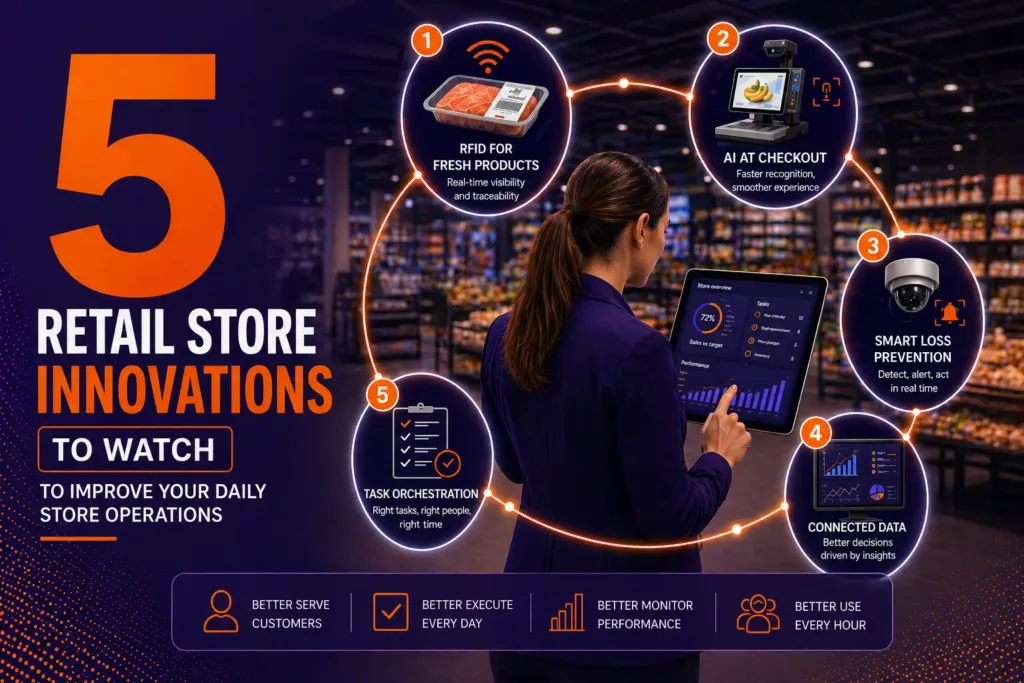
Here are then, according to me, 5 retail innovations that are going to change the game in the conduct of store operations in the coming years.
Is RFID perhaps (finally) making its way toward fresh food aisles?
Last year, Walmart announced its partnership with the player Avery Dennison. The goal: “to develop and test an unprecedented sensor technology allowing for the introduction of RFID tags in the meat department.” [1]
I see you coming… what changes the game?
RFID is, in itself, nothing new! It has been deployed in textiles for several years… Yes, I would be tempted to answer you, that is indeed the case. However, in the food sector, although tests were carried out years ago, the technology never convinced. At fault was its price, which was too high compared to the low margins generated by the sold products.
But today, this seems to be different! Why?
- One, Avery Dennison and Walmart have created RFID tags resistant to cold and humid zones. Before, the radio waves emitted in these zones were scrambled.
- Two, unlike dry products with low margins, fresh products—and for example here the meat department—have higher margins.
- Finally, three, add the problematic of date management, product freshness, and inventories, and you obtain the full relevance of this solution.

In any case, Walmart is convinced! This is part of its strategy to respect its objective of halving the volume of losses and waste by 2030! [2]
To illustrate it for you and better understand the mechanism, I found a video from Je Bosse en Grande Distribution at EuroShop. An employee gives us a demonstration.

For those who prefer reading, here is a small summary:
- Equipped with a mobile terminal, the inventory of fresh products is done in a few minutes. For one department, count on five minutes.
- The products to be removed appear instantly in red.
- Then, still equipped with a mobile device, the employee locates them and removes them from the shelf easily.
Beyond the time savings generated for inventories, it is the entire management of perishable products that is improved: more reliable stocks, better control of dates, reduction of losses… ultimately, better product freshness.
RFID is obviously not the only answer to the problems of managing short dates, product stock, and the management of markdowns/breakage. Solutions that we no longer even need to mention, such as Smartway, do it too. It even now offers the ‘smart reduction’ functionality. It suggests personalized discounts, adapted to the product and its sales pace, and this thanks to artificial intelligence.
[1] : https://www.packagingdive.com/news/avery-dennison-walmart-rfid-fresh-meat/803616/
[2] : https://www.packagingdive.com/news/avery-dennison-walmart-rfid-fresh-meat/803616/

Artificial intelligence at the checkout: streamlining is the keyword
Time savings for product search
When we do our shopping, two stops are mandatory. The scale to weigh fruits and vegetables and the checkout. Their common point? Waiting. And this irritant can quickly escalate when fruits or vegetables have not been weighed, forcing the cashier to redo the operation… and to search for the barcode.
And it is precisely to manage these products without barcodes that the FreshAI solution from Mettler Toledo [3] was designed. And it is already deployed in the Albert banner (Ahold Delhaize) in the Czech Republic.
Its operation is simple. The system relies on a camera integrated into a checkout or a scale. Thanks to visual recognition and the continuous training of artificial intelligence, it instantly detects fruits, vegetables, nuts, or bakery items. The camera certainly continues to learn as products are added to the department.
With a precision rate of 99% on the first three suggestions, this technology eliminates the memorization of PLU codes by employees and facilitates the onboarding of temporary staff.
Today, the solution goes even further. It is capable of identifying different types of products contained within the same bag. Result: the customer spends less time finding products on the scale, and at the checkout, customers or employees can directly identify and weigh products without barcodes, thus avoiding frictions related to waiting.
[3] : https://retail-optimiser.de/en/albert-speeds-up-checkout-with-ai-powered-item-recognition-from-mettler-toledo/
Reducing unknown shrinkage simply
If cameras already exist to detect abnormal behavior in-store and trigger alerts for security personnel, it is the way of doing things that is innovative here.
Indeed, the innovation carried by Netto Marken-Discount with Trigo Vision allows for the securing of self-checkouts without the intervention of a security member.
Without using biometric data, the solution identifies in real-time items that are unscanned at purchase or substitution errors at the checkouts. The clever side lies in the treatment of these anomalies. Because yes, rather than immediately alerting security, the system offers an ‘auto-correction’ to the customer. An approach that settles 80% of anomalies without conflictual human intervention. It is rather clever!
[4] https://www.trigoretail.com/
The data-store: when infrastructure becomes intelligent
For the fourth innovation, I did not want to talk about brands or products. Even if that would have been tempting, I grant you. Facilitation of the shelving process with rotating furniture, nano-fulfillment centers, POS displays unfoldable in seconds… There is plenty to choose from!
However, I felt it was important to talk about a major evolution. It began more than five years ago now, but today, it is becoming effective: the smart store.
For example, electronic shelf labels are already well-established in many banners. What is changing today is not so much their existence, but rather their role.
Indeed, we are witnessing a transition from a simply connected store to a point of sale driven by data. Equipment no longer contents itself with displaying information; it is becoming integrated sensors within a global system.
Electronic labels have evolved toward devices capable of reporting stock information. Environmental sensors continuously monitor preservation conditions. Stores are also becoming logistical hubs for some, and even more discreet technologies (e.g., RFID tunnels) allow for the tracking of product flows without human intervention.
What must especially be remembered is that data is no longer processed in silos.
The example of the Walmart data-store is particularly revealing
Information coming from RFID, physical or e-commerce sales, or logistics is integrated into a common system, accessible to all teams. The point of sale, the supply chain, and support functions now share the same reading of reality. This unification allows for the avoidance of contradictory decisions, the improvement of responsiveness, and the better coordination of actions.
We are moving from a store that observes to one that alerts, and then to one that anticipates. And this capacity to have the right information, at the right time, for the right person, profoundly transforms the way operations are managed.

Orchestrating all data to master in-store operations
Finally, the fifth innovation resides in the orchestration of operations. Because if all the technologies mentioned previously produce value, one must still be capable of making them work together… and especially of transforming the data and alerts they generate into concrete actions. Without that, they have no value. Worse, without a framework, they can quickly become a gas factory.
This is precisely the role of activity management solutions. They model the workload, adjust resources in real time, and prioritize high-added-value tasks based on priorities and daily contingencies. By centralizing data coming from different tools, they above all guarantee its proper transformation into actions on the ground. And the impact is far from marginal: without precise management, up to 30% of in-store time can be poorly used.
But as management becomes finer and more reactive, it must also move closer to the field.
This is where mobility takes on its full meaning.
Employees receive their individual and updated missions in real time, based on the activity and priorities of the store. They then know what to do, when, and can adjust based on what they observe, while sharing information with the rest of the team. We then move to a proactive and reactive management, where every decision relies on updated, shared… and immediately actionable data. And this is precisely what TimeSkipper allows you to do!
Conclusion: the trend toward an operational transformation
What I take away from these five innovations is that they do not stem from a futuristic vision of the store, but from a very concrete transformation of its functioning.
The point of sale is becoming more precise, more reactive, better coordinated. RFID on fresh products brings finer visibility to stocks. Artificial intelligence streamlines friction points. The data-store is evolving toward a decompartmentalized decision-making system. And orchestration allows for giving meaning to the whole.
The store of tomorrow will therefore not only be technological; it will, above all, be better managed. And in a context where every hour counts, it is probably there that the difference lies between an interesting innovation… and a true operational transformation.
FAQ: retail innovations for store operations
Why is RFID now relevant for the fresh food department?
Long shunned due to its cost and technical constraints, RFID is making its comeback in the food sector thanks to three key factors:
- Increased resistance: New tags now withstand cold and humid zones without the waves becoming scrambled.
- Profitability: Margins on fresh products (such as the meat department) are higher than on dry goods, justifying the investment.
- Optimized management: It allows for a complete inventory to be carried out in 5 minutes and for the instant identification of expired products.
How does AI help reduce checkout waiting times for products without barcodes?
Solutions like FreshAI use visual recognition to automatically identify fruits, vegetables, nuts, or bakery items on the scale or at the checkout.
- The system offers suggestions with 99% precision.
- It eliminates the need for staff to memorize PLU codes.
- It can even identify several different products in a single bag.
What is auto-correction for fighting unknown shrinkage?
Rather than systematically alerting security in the event of an error at self-checkouts, the system (deployed by Netto with Trigo Vision) offers the customer the chance to correct the oversight themselves.
This ‘clever’ approach allows for the resolution of 80% of anomalies without human intervention or conflict.
What is a "Data-Store" (data-driven store)?
It is a store where equipment (electronic labels, sensors, RFID tunnels…) are no longer simple displays, but integrated sensors that report information in real time.
Data is no longer processed in silos, but unified in a common system accessible to all teams.
The objective is to move from a store that observes to a store that anticipates needs.
What is the impact of poor activity management in-store?
Without an orchestration tool to centralize alerts and prioritize tasks, innovation can become ineffective.
- It is estimated that up to 30% of in-store working time can be poorly used without precise management.
- Solutions like TimeSkipper allow for these data to be transformed into individual tasks updated in real time for employees.